The Technology
What is Gel Printing?
Gel printing is a precision extrusion process for soft, viscous materials. Unlike filament-based 3D printing, it works with hydrogels, bioinks, silicones, and food gels, materials that behave more like living tissue than plastic. It's the core technique behind research in tissue engineering, soft robotics, and material science.
The Basics
Printing with
soft materials.
Most 3D printing is optimized for rigid, structural materials such as plastics, resins, and metals. These are powerful technologies, but they share a fundamental limitation. Conventional printers are not designed to work with soft, living, or shear-sensitive materials.
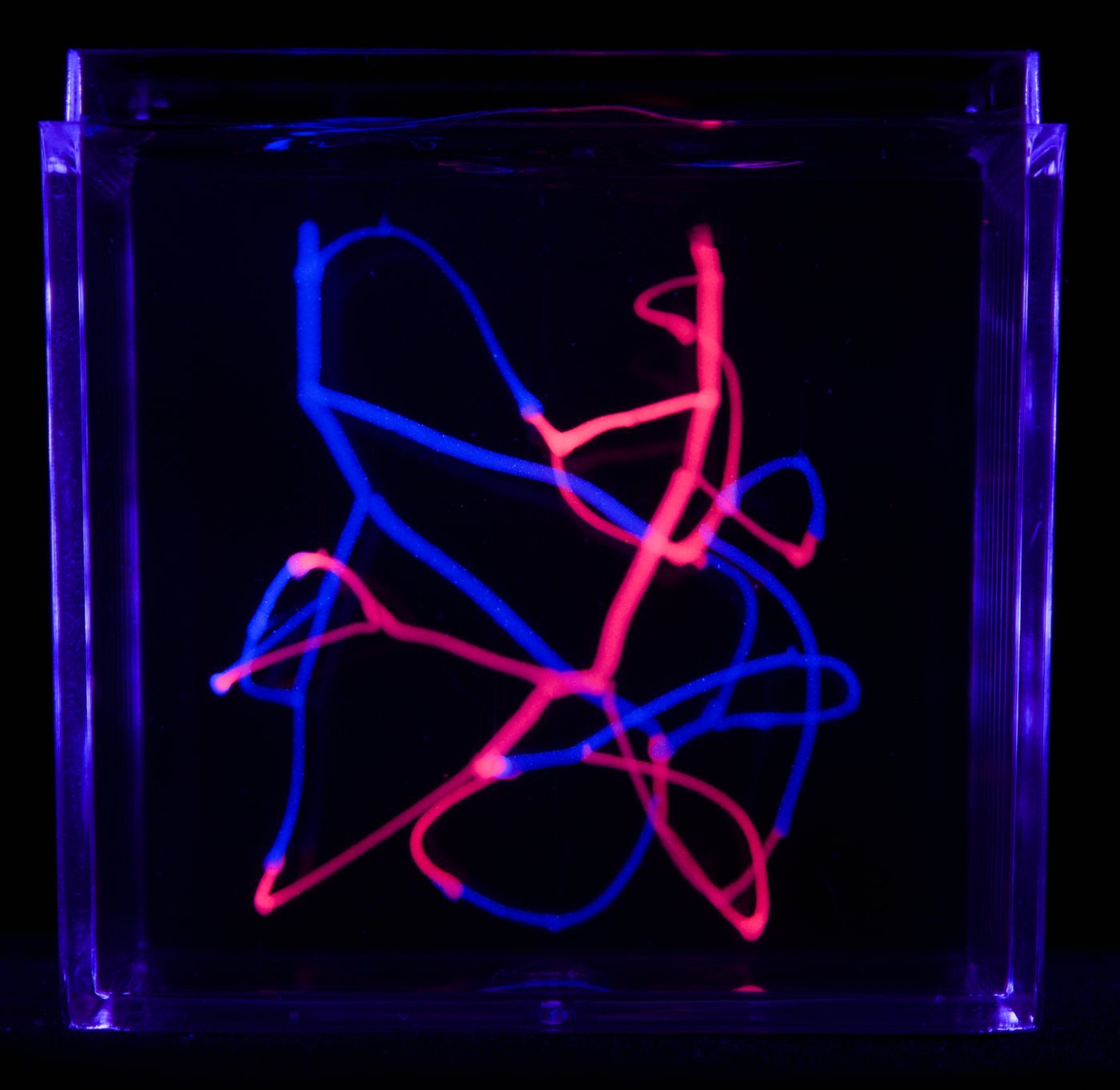
Gel printing is a distinct category. A precision syringe dispenses a viscous material through a fine-gauge tip, tracing paths defined by a slicing profile. The output is a three-dimensional structure built from any material that can be formulated as a flowable gel, including bioinks, food compounds, silicones, ceramics, and beyond.
The process requires hardware engineered specifically for gel-phase materials, with precise control over extrusion pressure, tip geometry, and material flow. When properly implemented, it enables structures that are not achievable through conventional manufacturing methods.
How It Works
Direct Ink Writing.
The technical name for the process is Direct Ink Writing (DIW), a form of extrusion-based printing where an ink (any gel-like material) is pushed through a syringe tip by a precision motor or pneumatic system.
The process is material-agnostic by nature. Any substance that can be loaded into a syringe and extruded through a fine-gauge tip is a candidate for DIW printing, from cell-laden bioinks to food gels to ceramic pastes. The material categories below represent the primary application areas.
01
Hydrogels & Bioinks
Water-swollen polymer networks, from simple alginate and gelatin to complex cell-laden matrices used in tissue engineering research.
02
Food Gels
Agar, gelatin, methylcellulose, and chocolate: edible gel materials for molecular gastronomy, dessert architecture, and culinary experimentation.
03
Silicones & Elastomers
Soft, flexible structures for wearable devices, soft robotics, and sealing applications.
04
Ceramics & Pastes
High-viscosity functional pastes for structural ceramics, conductive traces, and specialty coatings.
05
Artistic Mediums
Pigmented gels, clay slips, wax, and specialty resins for sculptural work, fine art fabrication, and experimental material exploration.
For Researchers
Research-grade
from day one.
The Printessa was developed inside the Skylar-Scott Lab at Stanford University, a world leader in bioprinted cardiac and vascular tissue research. Researchers were its first users, not an afterthought. Traditional bioprinters with comparable precision cost upward of $20,000. The Printessa One delivers the same core capabilities at a fraction of the cost, designed to be taken apart, modified, and built upon.
01
Cell Viability
Cell-laden bioinks printed with the Printessa demonstrated >95% viability compared to non-printed controls. Syringe-based extrusion applies minimal shear force, preserving living cells across a wide range of bioink formulations.
02
Well Plate Workflows
PrintessFlow includes a built-in arranger for 6-, 12-, 24-, 48-, and 96-well ANSI/SLAS plates. Automate multi-sample runs without manual repositioning, enabling high-throughput experimental workflows.
03
Reproducibility
Printed structures achieved 513 ± 11.4 µm measured pitch against a commanded 500 µm, and a Hausdorff distance of 0.25 ± 0.34 mm on complex 3D geometry. Consistent across print runs, meeting the standards required for publishable data.
04
Sterile Environment Ready
Compact and lightweight enough to be carried into a biosafety cabinet with one hand, supporting sterile cell-laden printing workflows without any infrastructure changes.
05
Tissue Engineering Applications
Functional trileaflet heart valves printed and validated under hemodynamic testing, achieving a mean transvalvular pressure gradient of 5.1 ± 0.3 mmHg and an effective orifice area of 1.7 ± 0.4 cm².